Luxury RV Resorts USA: Infrastructure & Asset Management Guide
The intersection of high-net-worth individual mobility and experiential hospitality has generated a distinct asset class within land-use development: the premium motorcoach enclave. While historically categorized under the broader umbrella of recreational vehicle facilities, these specialized destinations operate under fundamentally separate economic, structural, and operational frameworks. They represent a deliberate departure from transient camping models, positioning themselves instead as horizontally integrated luxury land holdings that mirror the amenities, exclusivity, and zoning complexities of private country clubs and master-planned residential communities.
Analyzing this sector requires a dual understanding of structural civil engineering and upscale hospitality management. The physical infrastructure demanded by modern, multi-ton Class A diesel pushers and custom fifth-wheel configurations requires meticulous civil planning. Heavy-duty load-bearing surfaces, advanced electrical grid distribution, and sophisticated subterranean utility designs are standard prerequisites. These sites do not merely accommodate vehicles; they integrate complex mobile residential power plants into localized municipal networks.
Furthermore, the operational architecture of these developments faces unique regulatory hurdles, shifting market demographics, and macro-investment trends. As land values along premium coastal and mountain corridors escalate, developers must balance high upfront capital expenditures against long-term site monetization models. These models often involve deeded lot ownership, structured rental pools, and high-end ancillary site improvements like custom coach houses and outdoor kitchens. This guide dissects the structural underpinnings, economic realities, and long-term asset management strategies that define the upper tier of mobile hospitality infrastructure.
Understanding “luxury RV resorts usa”
To evaluate the operational scope of Luxury RV Resorts USA, analysts must look past the superficial aesthetic of manicured landscaping and clubhouse facilities. At its core, a premium destination in this category functions as a decentralized luxury resort where the guest brings their own five-star accommodation. This dynamic shifts the focus of hospitality design entirely toward site infrastructure, spatial buffers, and localized land-use customization.
A common analytical failure is conflating these developments with high-density commercial campgrounds or destination RV parks. Standard parks maximize site yield per acre, often resulting in narrow gravel pads, shared utility pedestals, and minimal privacy buffers. Conversely, the upper echelon of land design prioritizes spacious lot layouts, deeded ownership structures, and extensive civil engineering designed to handle vehicles weighing up to 50,000 pounds without structural degradation or ground subsidence.
When institutional investors and land developers evaluate these properties, performance is gauged across three core pillars:
-
Infrastructure Resilience: The capacity of the resort’s private electrical grids, high-pressure water delivery, and dedicated sanitary sewer systems to manage sustained, peak-demand loads without pressure drops or voltage sags.
-
Asset Monetization Structure: The balance between deeded real estate sales (where individual lots are sold to owners with custom build-outs) and a managed rental pool that yields recurring hospitality revenue.
-
Zoning Compliance and Land-Use Longevity: The navigation of strict municipal codes, environmental impact assessments, and homeowner association (HOA) covenants that prevent site degradation and preserve long-term property values.
Deep Contextual Background
The evolution of high-end mobile tracking in North America is closely tied to the engineering milestones of the automotive and housing industries. Post-World War II infrastructure expansion led to the creation of the Interstate Highway System, which fundamentally altered recreational travel. Early mobile accommodations were modest, built for utility and brief stays rather than long-term luxury living.
The structural shift began in the late twentieth century with the introduction of the modern Class A motorcoach, featuring air-ride suspension systems, automated hydraulic leveling jacks, and multiple mechanical slide-outs. These vehicles grew significantly in length, height, and electrical demands, outstripping the design capabilities of older campgrounds. Owners of multi-million dollar rolling assets sought destinations that matched the security, amenities, and community design of premium country club estates.
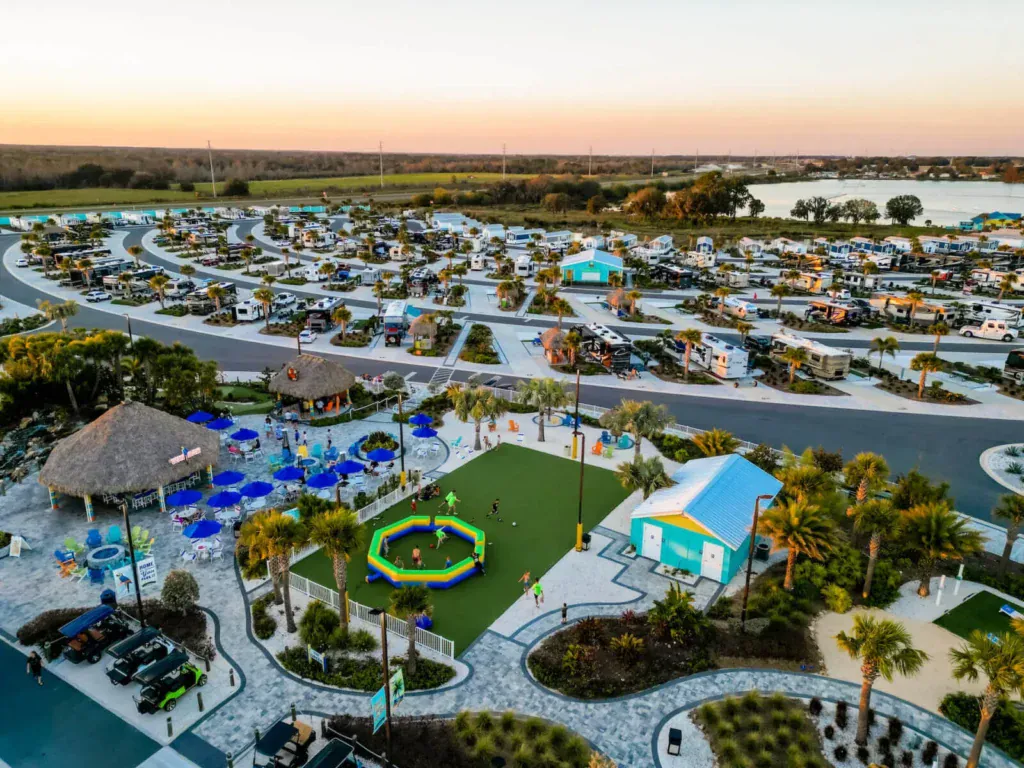
In the early 2000s, the emergence of deeded lot ownership flipped the traditional campground business model on its head. Land developers realized that high-net-worth individuals were willing to purchase individual lots for prices matching or exceeding local residential real estate. This injected significant capital into the sector, funding advanced underground engineering, expansive resort clubhouses, and upscale low-density layouts. Today, the landscape of luxury RV resorts usa is defined by this ownership-rental hybrid model, where sites are treated as tangible real estate assets that happen to accommodate ultra-premium mobile homes.
Conceptual Frameworks and Mental Models
To systematically evaluate the infrastructure of a premium motorcoach resort, developers and operators utilize several core frameworks. These mental models help balance engineering limitations against environmental and economic variables.
The Horizontal Hotel Framework
This model treats each lot as a horizontal hotel room where the guest provides the walls, bed, and interior amenities, while the resort provides the foundation, utilities, and exterior luxury environment.
-
Limitation: Unlike a traditional hotel room, where the property controls all maintenance, a horizontal hotel is vulnerable to external vehicle failures, electrical feedback loops, and varying guest configurations that can strain shared systems.
The Micro-Grid Utility Balancing Model
This framework treats the resort as an independent utility provider. It analyzes how the simultaneous draw of multiple 50-amp, multi-zone climate-controlled coaches impacts the site’s localized transformers, especially during extreme summer or winter weather.
-
Limitation: Upgrading private grid infrastructure to handle 100% peak demand simultaneously requires major capital deployment that may sit idle during shoulder seasons.
The Real Estate-to-Hospitality Yield Index
This financial model evaluates the speed and profitability of selling deeded lots to private owners versus keeping those lots in a corporate-managed rental pool to capture nightly hospitality margins.
-
Limitation: Selling lots quickly provides immediate liquidity but dilutes the developer’s long-term control over the property’s branding, maintenance standards, and rental pricing consistency.
Key Categories or Variations
Premium motorcoach destinations vary wildly based on local geography, regional climate, and design intent. The top tier of luxury RV resorts usa falls into several distinct structural categories, each presenting its own engineering challenges and operational trade-offs.
1. Master-Planned Deeded Country Clubs
These resorts operate identically to luxury golf communities. Owners buy their lots outright, pay monthly HOA dues, and must conform to strict architectural guidelines when building custom coach houses, casitas, or elaborate outdoor pavilions.
-
Trade-off: High property value stability and community cohesion are balanced by intense regulatory oversight and friction between permanent residents and transient renters.
2. Low-Density Waterfront Enclaves
Located along premium coastlines or major lake systems, these properties maximize waterfrontage by utilizing angled pull-in or back-in configurations that give every coach an unobstructed view.
-
-
Trade-off: Premium nightly rental rates and high demand are balanced by vulnerability to saltwater corrosion, strict environmental coastal zoning, and storm surge risks.
-
3. Mountain and High-Altitude Retreats
Carved into rugged terrain, these destinations focus on outdoor luxury, featuring massive stone fireplaces, multi-level terraced lots, and deep integration with natural landscapes.
-
Trade-off: Appeal to summer heat-escape travelers balanced by short operating seasons and complex grading and erosion control requirements.
4. Desert Oasis Resorts
Found in arid regions, these resorts lean heavily on extensive water features, artificial lakes, deep-well irrigation, and massive shade structures to combat high daytime temperatures.
-
Trade-off: High winter occupancy from cold-weather refugees balanced by astronomical utility and landscaping costs to maintain greenery in a desert environment.
5. Urban-Adjacent Premium Interchanges
Positioned just outside major metropolitan areas, these locations cater to high-end travelers visiting cities for culture, sports, or business who prefer their own secure, upscale accommodations over luxury hotels.
-
Trade-off: High year-round occupancy and business travel demand balanced by expensive land acquisition costs and tight acreage limits that compress lot sizes.
Summary Comparison of Premium Resort Paradigms
| Paradigm Category | Primary Revenue Driver | Dominant Structural Challenge | Average Lot Footprint (Sq Ft) | Target Vehicle Classification |
| Deeded Country Club | Lot sales, HOA assessments | Architectural code compliance | 5,000 – 7,500 | Class A Diesel Only |
| Waterfront Enclave | Premium nightly rental yield | Coastal erosion & utility sealing | 3,500 – 4,500 | Class A & Luxury 5th Wheels |
| Mountain Retreat | Seasonal long-term summer stays | Terracing, grading & frost heaving | 4,500 – 6,000 | All Premium Classes |
| Desert Oasis | Winter snowbird hospitality | Irrigation & private grid loading | 4,000 – 5,000 | Class A & Premium Towables |
| Urban Interchanges | Short-stay high-turnover rentals | Land cost & municipal zoning | 2,500 – 3,500 | Universal Luxury Vehicles |
Detailed Real-World Scenarios
Looking at real-world scenarios shows how these operational and structural principles apply in the field. These case studies highlight the balance between engineering solutions, guest expectations, and financial realities.
Scenario A: Mitigating Severe Grid Strain During Extreme Weather Events
During a prolonged heatwave in a desert oasis resort, every lot is occupied by a 45-foot coach running three to four rooftop air conditioning units simultaneously, alongside induction cooktops and high-end onboard electronics.
-
Structural Interventions: Operators must design the private electrical network with dedicated 200-amp step-down transformers for every small cluster of lots, alongside automated voltage regulators.
-
Operational Failure Modes: If the local utility provider experiences brownouts, the resort’s private grid can suffer voltage drops that damage sensitive inverter systems inside multi-million dollar coaches, leading to massive liability claims.
-
Second-Order Effects: The financial strain of installing industrial-scale backup generators or localized solar battery arrays increases HOA dues or overnight rental minimums, shifting the resort’s market positioning.
Scenario B: Navigating Coastal Zoning Laws and Environmental Protections
A developer attempts to construct a premium low-density waterfront enclave along a highly protected marshland or coastal dune ecosystem, facing intense scrutiny from environmental agencies.
-
Structural Interventions: Utilizing permeable pavers instead of poured concrete for the massive coach pads to allow rainwater to filter directly into the ground, alongside native landscaping that requires zero chemical fertilizers.
-
Operational Failure Modes: Strict regulations may ban any permanent structures on the lots, meaning custom coach houses or covered pavilions cannot be built, reducing the long-term appreciation value of deeded lots.
-
Second-Order Effects: The extensive environmental monitoring required by local authorities adds ongoing operational costs that must be absorbed by the resort’s nightly rental margins.
Scenario C: Managing the Transition from Developer Control to HOA Governance
In a master-planned deeded country club, the developer reaches the target sales threshold of 75% of available lots and must legally hand over control of the resort’s board, assets, and amenities to the homeowners’ association.
-
Structural Interventions: A complete civil and structural audit of all shared assets—including the clubhouse, pools, private roads, and main sewer lift stations—must be completed before the transfer.
-
Operational Failure Modes: Friction often arises between owners who want to restrict rentals to maintain privacy and the developer (or investor groups) who rely on a high-volume rental pool for ongoing revenue.
-
Second-Order Effects: If the new HOA implements overly restrictive vehicle age limits or construction codes, it can suppress lot resale values and reduce transient rental interest.
Planning, Cost, and Resource Dynamics
Developing and operating within the upper echelon of luxury RV resorts usa involves financial models that closely resemble high-end residential subdivisions rather than commercial campgrounds. Upfront engineering and civil prep work represent the largest share of capital allocation.
Capital Expenditure (CapEx) vs. Operational Expenditure (OpEx)
Initial spending covers deep grading, heavy-duty asphalt or reinforced concrete roadbeds, and extensive underground utility loops. Standard campgrounds can get away with shallow utility lines; premium resorts require deep-buried, insulated conduits to prevent damage from massive coaches driving over them continuously.
Operational spending is driven by intensive landscape maintenance, high-end concierge staffing, and the continuous upkeep of country-club-tier amenities like tennis courts, private dining rooms, and infinity pools. Salt spray along coasts or extreme freeze-thaw cycles in mountain regions accelerate the wear on concrete pads, requiring regular sealing and mud-jacking to keep the surfaces perfectly level.
Opportunity Costs and Land Acquisition Realities
Securing 50 to 100 acres of prime land near high-demand coastal or mountain hubs puts developers in direct competition with residential homebuilders and commercial developers. The choice to build a luxury coach resort means the land must generate higher per-acre yields through lot sales and premium rentals than it would as a standard single-family home development.
Estimated Financial and Structural Benchmarks
| Financial & Engineering Metric | Tier-1 Deeded Club | Waterfront Enclave | Urban-Adjacent Interchange |
| Development Cost per Lot | $150,000 – $250,000 | $200,000 – $350,000 | $90,000 – $140,000 |
| Concrete Pad Thickness / Strength | 6–8 inches / 4,500 PSI | 6 inches / 4,000 PSI | 5–6 inches / 4,000 PSI |
| Electrical Allocation per Site | 200 Amp (Capable of Casita) | 100 Amp (Dual 50A Hookups) | 50/30/20 Amp Standard |
| Target Occupancy (Peak Season) | 85% – 95% (Deeded/Rental) | 90% – 100% | 75% – 85% |
Tools, Strategies, and Support Systems
Operating an exclusive, high-density utility network disguised as a luxury resort requires specialized management tools and infrastructural support systems.
-
Automated Power Quality Monitors: Pedestal-integrated sensors that continuously track voltage consistency, automatically cutting power if a sag or spike occurs to protect both the coach and the resort’s transformer network.
-
Advanced Property Management Systems (PMS): Specialized software that tracks individual lot ownership, manages rental pool allocations, calculates owner revenue splits, and handles complex guest booking preferences.
-
Ground-Penetrating Radar (GPR): Used during annual maintenance cycles to scan underneath massive concrete pads, detecting underground soil erosion or shifting before a heavy coach cracks the surface.
-
Submetered Utility Tracking: Individual digital meters on every pedestal that track exact electricity and water usage, allowing operators to charge long-term guests based on real consumption rather than flat rates.
-
High-Capacity Lift Stations: Industrial-grade septic and sewage lift stations designed to handle the sudden, high-volume dumping of large onboard holding tanks without backing up or creating odor issues.
-
Architectural Review Committees (ARC): A structured governance body within deeded resorts that reviews and approves all custom lot improvements, ensuring structural and visual continuity across the property.
-
Enterprise-Grade Managed Wi-Fi Arrays: Fiber-optic backbones with dedicated, lot-specific access points designed to penetrate the heavy fiberglass and aluminum skins of premium modern coaches.
Risk Landscape and Failure Modes
The infrastructure of luxury RV resorts usa is vulnerable to specific, compounding failure modes. Because these systems are interconnected, a minor failure in one sector can quickly trigger a resort-wide operational crisis.
Structural Ground Subsidence
-
Root Cause: Poor soil compaction or water runoff control underneath the heavy concrete pads causes the ground to sink under the weight of 50,000-pound motorcoaches.
-
Compounding Effect: The sinking concrete puts stress on the buried PVC water and sewer lines running directly underneath it, causing hidden underground leaks that erode even more soil.
Utility Pedestal Thermal Overload
-
Root Cause: Continuous high-amperage draw combined with intense ambient summer heat degrades the internal breakers and brass connectors inside individual lot power pedestals.
-
Compounding Effect: The resulting electrical arcing can melt the pedestal housing, trigger a localized power blackout across an entire row of lots, and damage the electrical transfer switches inside the guest’s coach.
Holding Tank Chemical Shock
-
Root Cause: Excessive use of harsh chemical treatments by a large volume of transient guests kills the beneficial bacteria inside the resort’s private wastewater treatment plant or septic system.
-
Compounding Effect: The treatment system fails to break down waste effectively, leading to severe odor issues that spread across the resort, violating local health codes and forcing immediate operational shutdowns.
Governance, Maintenance, and Long-Term Adaptation
Preserving property values and ensuring operational longevity requires strict governance frameworks and disciplined preventative maintenance cycles.
In ownership-based resorts, the HOA board governs everything from vehicle restrictions (e.g., banning units over ten years old or under 30 feet in length) to the exact materials allowed for outdoor kitchens. In corporate-owned hospitality models, asset managers prioritize a continuous capital reserve fund to handle major infrastructure updates, like repaving roads or upgrading main electrical transformers every decade.
Institutional Resort Maintenance Protocol
-
Phase 1: Electrical Grid and Grounding Verifications
-
Torque all primary bus bar connections inside regional distribution panels to stop heat buildup.
-
Test ground-loop resistance at every lot pedestal to prevent electrical shock risks.
-
Infrared scan all breakers under load to identify hidden hotspots before they fail.
-
-
Phase 2: Subterranean Hydrology and Waste Systems
-
Scope main sewer lines with cameras to detect cracking from heavy vehicle traffic.
-
Check backflow preventers on high-pressure water lines to stop system contamination.
-
Clean and service grease traps at the hard clubhouse and outdoor pavilion kitchens.
-
-
Phase 3: Civil Surfaces and Structural Leveling
-
Check concrete pads for hairline cracks or tilting using precision digital levels.
-
Clear expansion joints on concrete surfaces and replace worn silicone sealants.
-
Inspect retaining walls and terracing systems in mountain resorts for structural shifting.
-
Measurement, Tracking, and Evaluation
To maintain structural integrity and maximize financial returns, resort operators track a combination of hard operational metrics and qualitative experiential signals.
Leading vs. Lagging Indicators
Leading indicators provide early warning signs of upcoming issues, allowing operators to schedule repairs before a major failure occurs. Examples include rising temperatures inside electrical transformers, minor drops in water pressure during peak hours, or an increase in lot modification requests that stretch existing HOA codes. Lagging indicators measure events that have already happened, such as RevPAR (Revenue Per Available RV Lot), annual expenditure on electrical pedestal replacements, or guest friction scores regarding Wi-Fi connectivity.
Real-World Asset Documentation Models
-
Transformer Loading Logs: Monthly reports tracking peak kilowatt usage against a transformer’s maximum capacity, indicating when a sector needs an upgrade.
-
Pedestal Maintenance Histories: Digital logs tracking every repair, breaker replacement, or outlet failure on a specific lot, helping isolate chronic electrical issues.
-
Lot Slope and Settling Matrices: Annual geological surveys tracking the elevation stability of concrete pads across different areas of the resort.
Common Misconceptions and Oversimplifications
Myth 1: High-end RV resorts are just glorified campgrounds
A true premium resort operates under entirely different land-use, engineering, and financial models. Traditional campgrounds focus on high-density transient stays with minimal hookups. Premium enclaves utilize low-density, engineered real estate design, robust private utility grids, and luxury amenities that compete directly with five-star stationary resorts.
Myth 2: Poured concrete pads are completely maintenance-free
While concrete is highly durable, the continuous weight of heavy Class A coaches combined with shifting subsoils will cause cracking, tilting, or settling over time. Without regular inspections, sealing, and occasional mud-jacking, a concrete pad can degrade to the point where it risks damaging a coach’s automated hydraulic leveling system.
Myth 3: Expanding resort Wi-Fi is as simple as installing more home routers
The heavy fiberglass, steel, and aluminum framing used in modern premium coaches acts as a natural shield against wireless signals. Providing reliable internet access requires an enterprise-grade network with dedicated, directional access points focused on every single lot, paired with a substantial fiber-optic backbone.
Myth 4: Any high-end resort can easily accommodate luxury fifth-wheels
Many of the most exclusive country-club-style destinations maintain strict “Class A Motorcoach Only” covenants. These rules are implemented to maintain visual uniformity and preserve property values, meaning even the most expensive luxury towable configurations are legally barred from entry.
Myth 5: A 50-amp hookup provides identical power quality everywhere
The power arriving at a pedestal is highly dependent on the resort’s internal grid balancing. If a resort scales its capacity incorrectly, the simultaneous draw from multiple coaches during hot weather can cause voltage drops. These drops trip the coach surge protectors and cut off the climate control systems when they are needed most.
Myth 6: Deeded lot ownership eliminates all developer overhead
Even after selling out a subdivision of deeded lots, developers or management companies typically maintain control of the rental pool, on-site concierge services, and common amenities. This requires an ongoing operational structure supported by robust HOA assessments and shared nightly rental margins.
Ethical, Practical, or Contextual Considerations
The rapid expansion of luxury RV resorts usa has created ongoing friction with local municipal planning boards. Because these developments accommodate mobile vehicles, developers occasionally try to classify them under lenient campground zoning laws to bypass the stricter building codes, school district taxes, and environmental impact studies required for permanent residential subdivisions.
This regulatory gray area forces local governments to update their definitions of transient versus permanent land use. A multi-million dollar lot featuring a permanent brick coach house, full plumbing, and an outdoor pavilion is functionally a luxury home, even if the primary living space has wheels. Ensuring these upscale enclaves pay their fair share of local infrastructure taxes while respecting the environmental limits of sensitive coastal and mountain corridors remains a critical challenge for the industry.
Conclusion
The market for premium motorcoach infrastructure has matured into a resilient, sophisticated segment of the North American hospitality industry. No longer a niche offshoot of traditional outdoor recreation, these properties represent a unique blend of high-yield real estate development and horizontal hospitality management. The long-term success of these operations depends on invisible design choices: heavy-duty concrete work, resilient private utility grids, and clear, enforceable community governance models.
As luxury vehicles continue to grow in mechanical and electrical complexity, the destinations that host them must innovate to stay relevant. The properties that maintain strict architectural standards, protect their utility networks against extreme weather, and balance the needs of permanent lot owners with transient renters will continue to see strong asset appreciation. By focusing on engineering excellence and high-end community design, premium enclaves provide a definitive blueprint for the future of mobile luxury real estate.